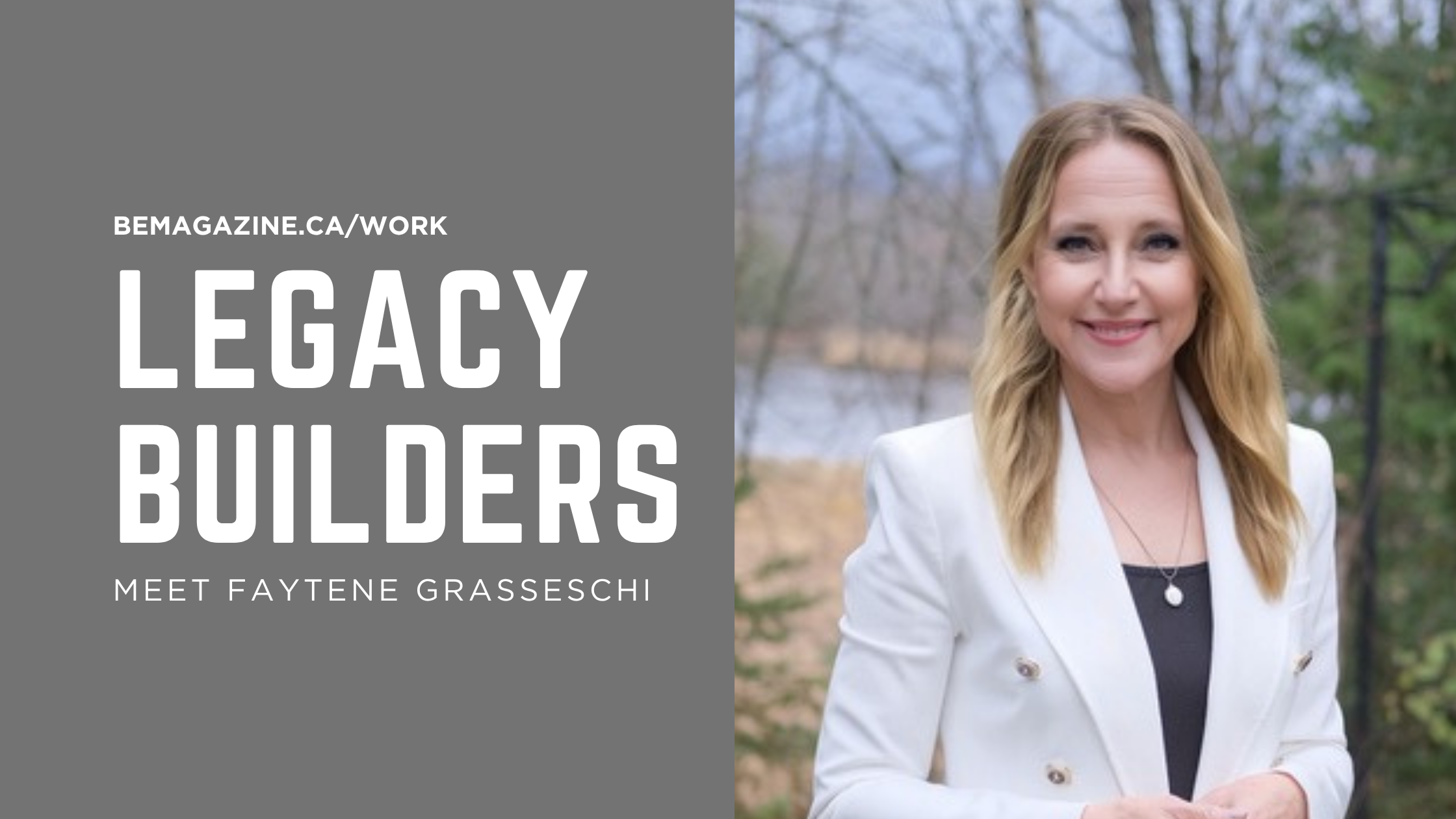
The Legacy Builders: Meet Faytene Grasseschi
Welcome to The Legacy Builders — a special feature series I’ve created as Co-Editor of BE Magazine’s Work section. I launched this series to spotlight women who are doing more than showing up for a job — they’re leading with conviction, building with purpose, and using their work to leave something that lasts.
You’ll hear directly from women influencing boardrooms, raising families, launching ideas, leading classrooms, and shaping culture — each sharing how faith and purpose show up in the work they do. Through these candid Q&As, you’ll find insight and encouragement to bring your beliefs to the front lines of whatever you’re building — from your business to your daily life.
This series is a reminder that Monday isn’t something to survive — it’s a space to show up with vision, faith, and fire. Whether your work already flows from what you believe — or you’re still finding your way there — you’re in the right place.
Read on, be inspired & let’s get to work!
Amanda
********************************************************
Meet Faytene Grasseschi
Faytene Grasseschi is the host of Faytene.TV a cutting-edge show speaking directly to the issues shaping Canada with a Biblical worldview. Her work has been featured on various national & regional news outlets across Canada. She was recognized by Charisma Magazine as one of the world's top 21 most influential next-generation leaders and has been awarded the ANCJ Emerging Leadership Award in Jerusalem. Faytene has spoken to Parliamentary Committees and is regarded as a voice on social justice issues both at Parliament and grassroots forums across Canada.
What first sparked your passion for the work you’re doing today — and how did your values or faith influence your decision to start?
The track I am currently on began in the early 2000s, when I was serving in a war zone in Liberia, West Africa. During that time, I was a faith-based humanitarian missionary (with Hope for the Nations) on the front lines, picking up dying and malnourished children one at a time in villages and working alongside other NGOs to help save lives.
After a few months, word spread that there was a missionary woman willing to help. Every morning, when I opened the door to the missionary compound where I was staying, there would be a lineup of people with desperate needs. Some were elderly individuals caring for starving children. Some were women looking for work. Others were small children begging for money for shoes and school uniforms because, at the time in Liberia, children could not attend school without a uniform. Every single day, I was confronted by overwhelming need.
One night during my prayer time, I felt the Holy Spirit impress a question upon my heart: Why do you have a job? In other words, why was there such an immense mountain of need in front of me every morning? The obvious answer was that Liberia had been torn apart by war, and the greatest victims of dysfunctional leadership and conflict were the elderly, the children, and the poor.
In that moment, I immediately thought of Psalm 72, which speaks of God’s heart and how He uses strength and authority to govern with deep tenderness, compassion, and regard for the poor. God always uses His power to lift people up out of the dust. When leadership does not reflect his heart, it is the vulnerable who are hit the hardest. That realization hit me profoundly. I understood that I could spend my entire life picking up desperate and dying children one at a time, or I could work to touch the heart of a king, and in a moment, conditions could change for an entire ocean of vulnerable children and needy people.
At the time, I did not fully understand it, but what was taking root in my heart was the realization that policy matters — and therefore advocacy matters. Policy matters because it impacts people. At the end of every law, every governmental decision, and every public policy, there is a human being who will either be positively or negatively affected. It was this revelation that led me, upon returning to Canada, to devote myself to prayer for our leaders, but also to advocacy. I came to believe that effective advocacy, when translated into sound policy, has the power to liberate the poor, the broken, and the vulnerable.
How do you stay connected to what really matters while growing your career?
Community is critical. I have always tried to be intentional about surrounding myself with a core group of advisors who believe in what I am doing and who have pure hearts to speak honestly into my life. I established many of these relationships early on in our work, and they have remained with me for decades.
I also have peers with whom I maintain an open-door policy. These are people who have the freedom to check in, ask the tough questions, and help keep me grounded in what matters most. In addition to authentic and healthy community, it is critical that we, as leaders, maintain a strong daily devotional and prayer life. It is in those quiet moments with the Lord that He recalibrates our hearts, brings adjustment and conviction where needed, offers comfort where needed, and speaks clearly in ways that give us confidence to continue moving forward. To stand the test of time, we need both a strong vertical relationship of personal faith and healthy horizontal relationships with others.
I would also add the importance of being intentional in different seasons to surround yourself with experts and mentors in the specific areas where you need to grow. I have found that these mentoring relationships do not always remain the same from season to season, but they can be absolutely critical in helping you step into the next phase of fruitfulness.
Lastly, and probably most importantly, I try very hard to maintain an eternal perspective by regularly asking myself a simple but sobering question: If I were to die today, would I have any regrets? If the answer is yes, then I know I need to make an immediate adjustment. Sometimes that adjustment means prioritizing more time with my family. Reminding myself that my life is a mentor to my children, so how I live it matters. Other times it means spending more time in prayer, investing in a relationship that needs reconciliation or attention, or letting go of things that may have been right for a former season but are no longer meant for this one.
James 4:14 reminds us, that our life is but a vapour. Each day is precious, and we need to spend it in light of eternity. We should live in such a way that, when we look back at the end of our journey, we can authentically say that although we may not have done everything perfectly, the trajectory of our lives was aligned with our deepest values and convictions. Regret is expensive. I want as little as possible.
What kind of impact do you hope your life and work will have — on your community, the world, or future generations?
We all have a different race to run, but my prayer is that my life will inspire others to fully run their race with purpose, focus, wholeheartedness, and in light of eternity. As I get older, I find myself increasingly thinking about succession. If what we have done or built dies with us, then in many ways, I believe we have failed. I am not necessarily speaking about structures or organizations, but about passing on a heart, a DNA, and a set of values. The Bible calls this discipleship.
My prayer is that at the end of my life, I will be able to look across the landscape of our nation and see at least a few next-generation leaders whose lives, character, and walk with God are stronger because of the influence I was able to have on them, by God’s grace. Of course, if it is in Heaven’s heart, I would also love to see the organizations we have built continue to thrive far beyond my lifetime — this of course is the heart and goal of the newly established National Day of Prayer. When we inaugurated it last year (July 11, 2025), the goal was not for an event in 2025, but 2075. Our prayer is that when we are done running our race, we will have an authentic baton to pass to the next generation.
We are constantly scanning the horizon, asking: Who are the individuals who carry a heart and a DNA that extend beyond their own ministry, platform, or business? Who are the people who genuinely carry Heaven’s purposes for a nation from sea to sea? Those are the kinds of leaders we want to invest in, walk alongside, and help strengthen for the future.
Are there personal habits, routines, or spiritual practices that help you lead with clarity and purpose?
Honour the Sabbath.
Stay grounded in the Word of God. Drink lots of water. Let your body rest. Regularly examine your heart. Journal. Forgive those who have hurt you.
Meet with a trusted counsellor or mentor at least a couple of times a year to ensure your heart stays healthy, clean, and you don’t get “stuck”. Leaders experience trauma on a regular basis — it will either make you bitter or better. Always turn pain into gain.
Create space for stillness before the Lord. Be real. Be raw. Be honest about where you are, but don’t get stuck there. Get up and move forward.
Above all, keep your heart clean. Choose your battles. Avoid drama.
Laugh lots. You need it.
What were the biggest risks you’ve taken — and how did faith guide you through them?
I don’t feel like I have ever had a season of life that did not involve some element of risk and faith, so in many ways it has become a regular part of my rhythm. However, I would say that the very first time I went to serve on the international mission field was one of the most significant steps of faith I have ever taken. I was a young woman with very little life experience, heading directly into the heart of a war zone simply because I believed that was what I was called to do. I bought an open-ended ticket and had no idea when I would return.
In retrospect, I feel deeply compassionate toward my mother and the stress she must have carried as I ventured into the unknown. While there, every day was filled with purpose, urgency, and a desire to help save lives. My faith led and guided me each day. Some days, direction felt more tangible than others, but looking back, the fingerprints of heaven’s providence were evident at every turn and in countless ways. I am grateful to say that not only did I survive that war zone, but children’s lives were saved, and my own heart was marked in a way that has shaped the entire trajectory of my life and calling.
Over the last twenty years, there have been many other steps of faith, most of them financial in nature. Through it all, I have consistently found that Heaven’s provision is connected to Heaven’s vision. As long as I work hard to remain tethered to authentic purpose, the provision somehow always seems to materialize by the final paragraph of the chapter. This is what it means to walk on water. It does not make sense, but it works.
Connect with Faytene: on on faytene.ca, faytene.tv or at the National Day of Prayer www.nationaldayofprayer.ca
#TGIM
***
📩 Know a woman who's leading with conviction and building something that lasts?
We’re on the lookout for Legacy Builders — the women living their purpose in the boardrooms and communities across the nation. Nominate someone (or yourself) to be featured in an upcoming spotlight. Email Amanda at: Editorials@Bemagazine.ca
🚀 Want more bold insights at the intersection of faith, purpose, and leadership?
Explore other stories in the Work section and follow Amanda @buildwithbizu or @amandastassen for more strategic insights to help you lead with clarity, grow with intention, and build what matters.