

By Jennifer Maxwell
How seeing the world differently can change the way we love, lead, and connect.
When our boys were young, my husband and I were standing in the backyard. I have a knack for finding four-leaf clovers, so I began scanning the ground. I noticed he was looking down at the grass, too.
“Are you looking for clovers?” I asked.
“No,” he replied. “I'm looking for poop.”
We laughed. Heartily, as if this moment captured our entire relationship.
Now, you might think this is a story about positivity versus negativity but that's not where I'm going with this. After 20 years of marriage and 22 years as a personality practitioner, I've learned something more important: our differences can make us a better team.
I'm usually the one looking for possibilities everywhere: other explanations, new interpretations, making lemonade out of life's lemons. My husband? Practical, grounded, and spotting potential obstacles so we don't step in them - literally and figuratively!
The trouble starts when we assume our way of seeing things is the right way. And we ALL think our perspective is the right one.
Different doesn't mean wrong
When my husband and I first started dating, everything was going beautifully - until our first fight. You know the one, about three months in, that has you convinced it's just not worth it?
Then he called. “Honey, I'm sorry. I'm not a jerk. I'm just a D personality.” I had no idea what he was talking about, but he convinced me to come over so he could explain.
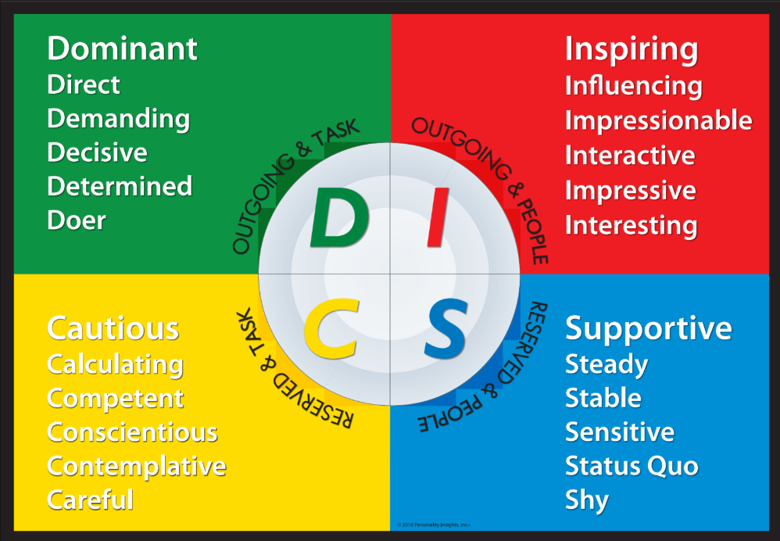
He introduced me to DISC, a tool for understanding different personalities. He didn't just tell me about it; he showed me. He described how I tended to see the world through rose-coloured glasses, focusing on possibilities and avoiding conflict. He even said, “There's a reason your friends call you ‘Fun Jen.’”
I remember thinking, “This guy gets me. Like, really gets me. And I'm going to have to marry him now.” That was the moment I fell for him. Hook, line, and sinker but we were so different. How was this ever going to work?
Without missing a beat, he said, “God made us different on purpose. We need each other - you to soften my edges, and me to help you be more… edgy?” And for added measure, in a cartoon voice, he wrapped up the moment with “You complete me,” fake sign language and all. Just like in Jerry Maguire, he had me at hello.
That moment was about more than a communication strategy. Being fully seen and understood cracked the door wide open for grace and reciprocity. I actively wanted to learn what made him tick. And that moment also set my life on a completely different path. Now I wanted to know what made everyone tick!
In our relationship, we practiced. I learned not to take every direct comment personally. He learned that being a little more playful opens up a world of possibility. And yes, we still need to remind each other of this from time to time.
Understanding is an invitation, not a surrender.
This isn't about surrendering to someone else's personality or excusing behaviour that hurts us. It's about creating enough space to observe what's happening before deciding what it means.
We don't have to agree with everyone, dismiss our own feelings, or abandon our boundaries to understand others in a meaningful way. We haven't surrendered our perspective. We've simply made room for another one.
Try swapping lenses
We all see the world through a lens shaped by our experiences, preferences, and personality. Because it feels natural to us, we can mistake it for the only way to see things but different doesn't mean wrong.
Think about your spouse. The decisiveness you once admired might now feel bossy. Their carefulness might seem negative, or their desire to talk things through might frustrate you when you just want to get things done.
Before frustration turns into resentment, what if you tried looking through their lens?
When I introduce people to DISC, I start with two simple questions:
Are you more outgoing or more reserved?
Are you more task-focused or more people-focused?
These preferences help explain why we approach situations differently. The goal isn't to put people in boxes, but to recognize that we don't all see things the same way.
The next time someone's behaviour frustrates you, ask yourself:
1. What might this person be trying to accomplish?
2. How could I communicate what I need in a way they're more likely to hear?
Two simple questions can create space between what someone does and how we interpret it. Sometimes, what feels personal isn't personal at all. Understanding another perspective can help us find a better way forward together.
Beyond our homes
Imagine bringing those same questions to work. The boss who seems overly critical may be focused on results. The colleague who talks everything through may be building connection, while the teammate who questions every detail may be preventing a costly mistake.
We can't control how others see the world, but we can take responsibility for how we connect with them. When we stop expecting everyone to approach things the way we do, our differences become opportunities for better communication and stronger collaboration.
A practice worth choosing
What if we stopped assuming our first interpretation tells the whole story and learned to swap lenses instead? We might discover a better way to communicate, a new solution to a familiar problem, or more grace for someone whose approach differs from our own.
The next time someone's perspective clashes with yours, pause. Get curious. Look again. You may not change their perspective, but you can choose how you respond.
Simply put, our perspective is practised. And when we practise seeing things differently, we create more room for grace, connection, and peace.
Jennifer Maxwell is a "Professional Uplifter" with 20+ years of experience in human behaviour and communication, helping people connect and respond more intentionally by shifting the way they see themselves, others, and the situations they're navigating. Learn more at www.jennifermaxwell.ca or connect on LinkedIn.
