The Eyes I Inherited
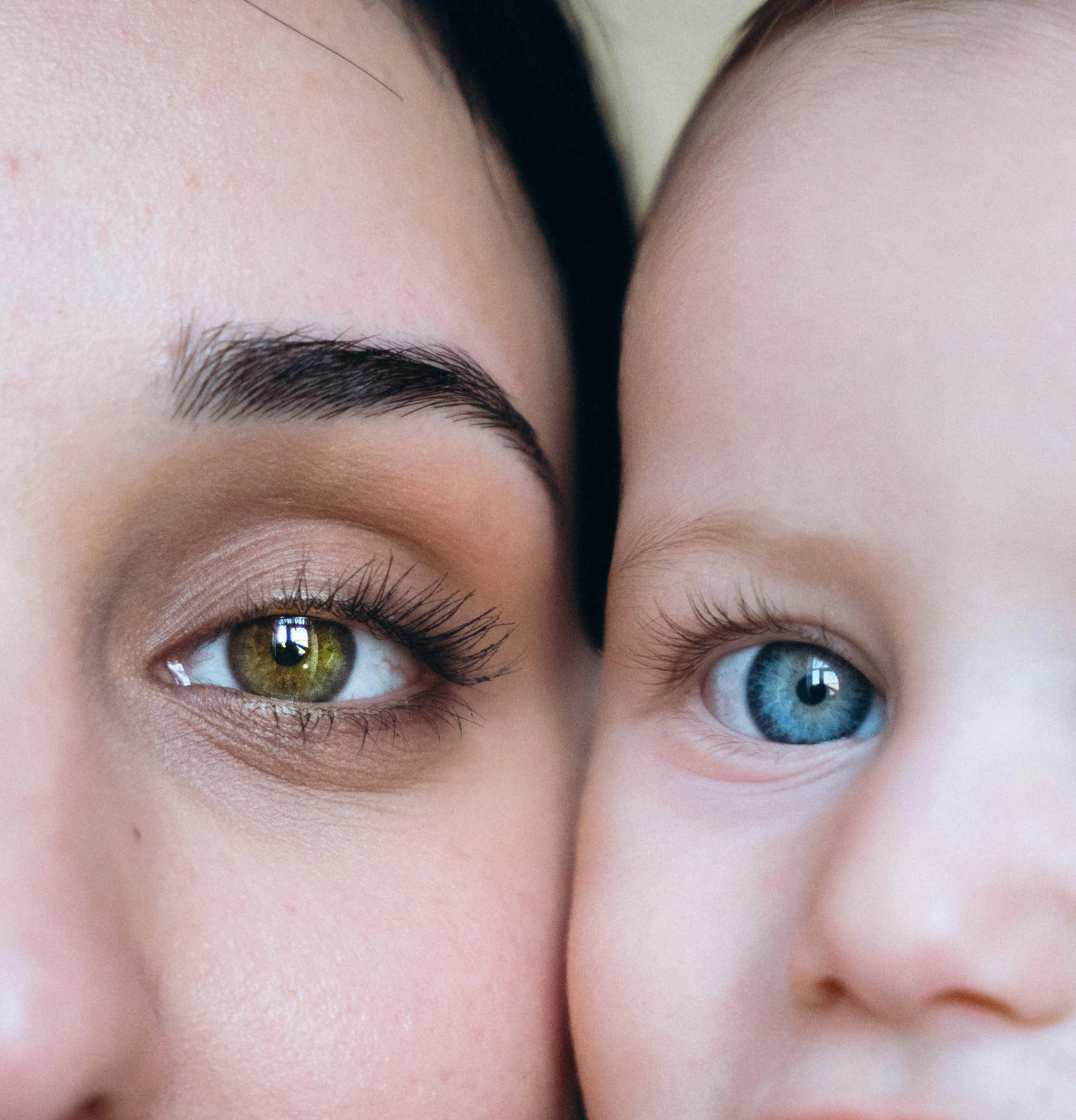
I fear I have my mother’s eyes…not in color, not exactly in shape. Inheritance has a way of revealing itself over time.
My mother is now legally blind. She lives with age-related macular degeneration and glaucoma, and she is preparing for her second partial cornea transplant. Watching her has changed the way I think about my own vision; both what I can protect, and what I may one day have to surrender.
I didn’t always think about my eye health. Now I’m paying attention in a way that feels both practical and a little urgent. To clarify - not obsessive, but intentional. Because stewardship matters.
Here are a few things I’ve woven into my routine – thoughtful habits rather than fear-based fixes.
• Morning sunlight without sunglasses: getting natural light into my eyes early in the day to support circadian rhythm and signal wakefulness to the body.
• Blue light awareness, not avoidance: we need blue light during the day, but I reduce exposure after sundown to support sleep and recovery.
• Evening wind-down with blue light blockers: especially when screens are unavoidable.
• Eye movement exercises: simple practices like looking left to right, near to far, gently reminding the eyes they were designed to move, not just stare.
• Hydration: basic, but foundational.
• Omega-3 support through diet first, and supplementing as needed.
• Red light therapy: a newer addition, used intentionally under doctors’ supervision.
None of this is extreme. And none of it is a guarantee.
(For clarity, I’m not a medical doctor, and none of this is intended as medical advice.) I’m simply paying attention, because I’ve come to discover I can do everything right and still not control the outcome.
My mother never bio hacked. She didn’t optimize her circadian rhythm or track her hydration or think about blue light exposure. And she hasn’t accepted what’s happening to her eyesight in some perfectly peaceful, storybook way. At almost 95, there is frustration. There is confusion. There are days when the world doesn’t meet her the way it once did.
But what I’ve observed her do is something else entirely: adapt.
She has learned her space by memory since she still lives alone independently. She knows the exact placement of furniture, the way light falls at different times of day. She moves carefully - not because she’s fragile, but because she’s precise.
She still has her hair done every week. She still dresses impeccably. She still gets her nails done every other week. Her vision may have changed, but her standards have not.
At times, her brain fills in what her eyes no longer can, part of Charles Bonnet syndrome, a condition that can occur alongside vision loss. She knows the images aren’t real. She laughs as she points them out to me, as if to say, oh boy, this is what my brain is doing now. She has a kind of awareness most of us never have to develop.
She’s taught me that vision isn’t just about what you can see. It’s about how you keep moving when what you see changes. It’s about learning a new way to live inside the same life without losing your footing in it.
There’s a passage in 2 Corinthians where Paul talks about a thorn in his flesh, an affliction he pleaded with God to take away. Scholars have various theories, but some believe it may have been related to his eyesight. We don’t know for certain. But we do know the answer he received: “My grace is sufficient for you, for my power is made perfect in weakness.”
That’s not what I want to hear.
I want prevention, solutions, control. I want to know that if I do the right things, I can secure the right outcome.
My mother has lived a version of this long before I ever thought about it.
When she was young, before she was married, her own mother was dying of cancer. She prayed. She fasted. She postponed her wedding. She believed God would heal her mom. He didn’t. Her mother died before she ever walked down the aisle. And yet, she never lost her faith. Hers is not the kind of faith that depends on outcomes, but rather the kind that stays, even when the answer is no.
When I look at her now, at almost 95, navigating a world she can no longer fully see, I don’t just see loss. I see the same faith. Steady. Practiced. Unshaken.
As for me, I’ll keep wearing the blue light glasses. I’ll keep chasing the morning light. I’ll keep doing the small, faithful things that support the body I’ve been given.
But I’m also learning to hold all of it loosely.
Because ultimately, the future of my eyes is not in my hands.
It’s in the One my eyes are fixed on. The One who made me fearfully and wonderfully. The One who asks for our love and faithfulness even if the answer is no.
That is the real inheritance from my mother.
What I’m Using (and loving)
These aren’t guarantees, just tools I’ve chosen. (Consult your own healthcare provider before starting any new therapy.)
• Blue light blocking glasses: I wear the Lola 2.0 Wind Down™ (non-prescription) in the crystal rose cat-eye frame from ROKA. You can find it here. They filter evening blue light and feel chic to wear, which means I stay consistent.
• Red light therapy: I use a device from KALA Therapy, which I’ve featured previously in Be Magazine. It has become part of my daily routine.
• Eye exercises: Screen Fit offers accessible tools to support eye movement and reduce screen strain www.screenfit.com.
• Omega-3 support: I prioritize high-quality seafood in my diet regularly, and supplement with Nordic Naturals. Buy it here on Amazon.