The Daughter Who Walked Away
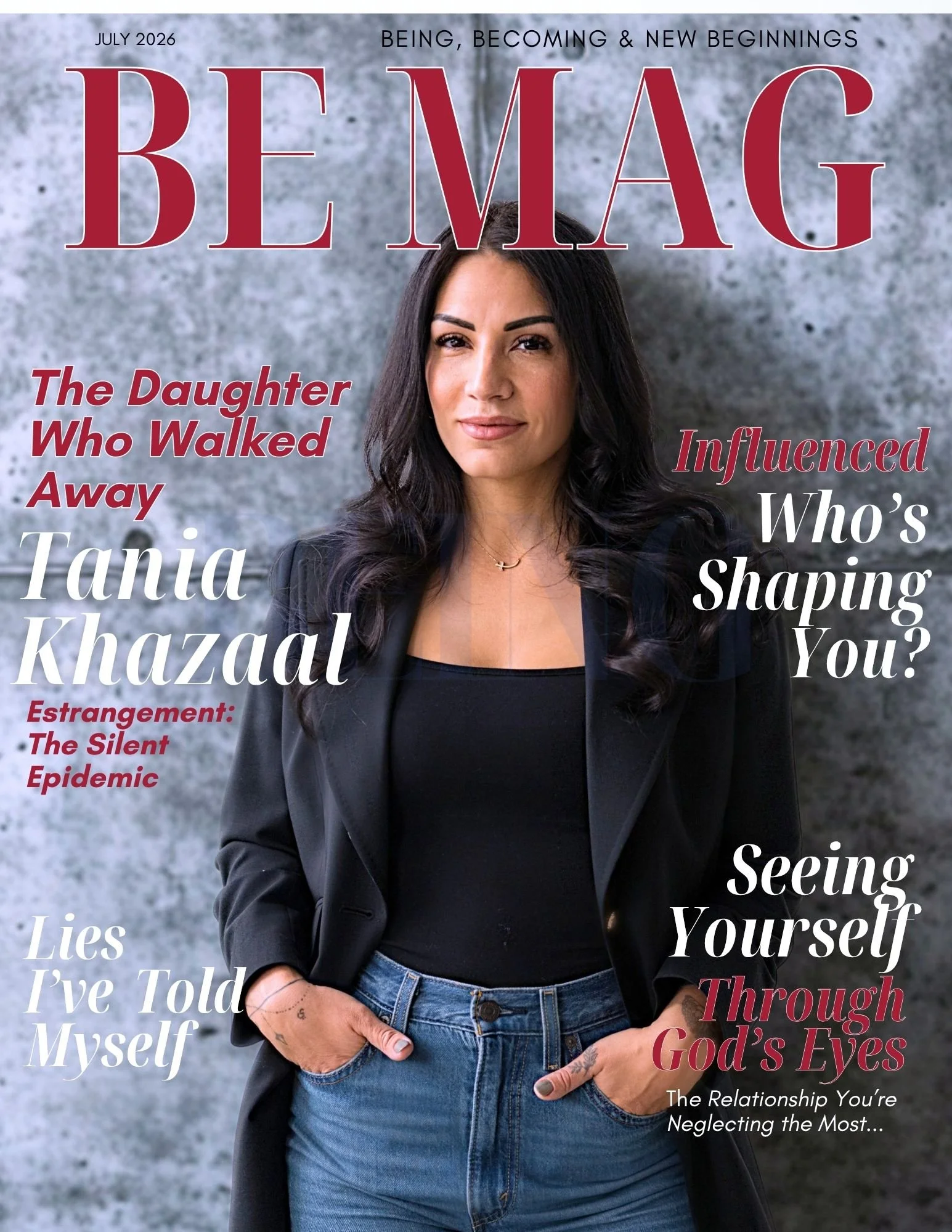
She spent nearly two years estranged from her mother. Today, Tania Khazaal is helping families find their way back to one another.
It started, as some of the deepest wounds do, with something that may have looked small from the outside: a birthday.
Tania Khazaal was 15 years old when her birthday passed without the celebration she had hoped for. No gift. No cake. No moment that made her feel especially seen. Days later, her older sister was celebrated. For someone else, it may have been disappointing but for Tania, it became something more: a story about being overlooked, less loved, a statement about where she fitted in her own family. And like many stories we begin telling ourselves when we are young, it did not stay in childhood. It followed her.
Tania grew up as the middle child in a family that had known financial struggle. Her older sister had health challenges and shared a close bond with their mom. Her younger brother, the first boy, naturally drew attention too. Somewhere in the middle, Tania began to feel invisible. Not abandoned, exactly, not unloved in a way that could be easily explained but unseen in the places where a child most wants to be noticed. Over time, that feeling hardened into interpretation and slowly, it became evidence. Then evidence became distance and by her mid-twenties, Tania had cut off her mother all together.
At the time, she believed she was protecting herself, that her mom was toxic and that the pain she carried had one clear source. Like so many adult children navigating family wounds, she had attached words to what she felt: harm, toxicity, emotional damage, narcissism but healing would eventually ask something more difficult: to take a second look and revisit the past.
Estrangement is often spoken about in absolutes. One person is right. One person is wrong. One person leaves. One person is left behind. But as Tania started to study emotional pain, human behaviour and the way unhealed wounds shape relationships, something shifted. She started to see her mom not only as the person who had hurt her, but as a woman with her own limitations and pain, her own way of loving. It may not have matched what Tania needed but was not necessarily the absence of love. Though the realization did not erase the hurt, it changed what healing could look like.
Tania began to understand that some family fractures are not caused by a lack of love, but by generations of unmet needs, misunderstood intentions and emotional patterns no one ever had the tools to name. That is often where healing begins; not when someone finally says the perfect apology, but when a heart becomes willing to see the human being on the other side of the wound.
For Tania, that meant releasing the expectation of how to be loved by her mom in the exact way she had longed for and learning to recognize it in the form it was being offered: imperfectly, sometimes clumsily but still there. That shift softened something in her. It also softened the way she saw her sister, her family and eventually herself.
Today, Tania speaks about estrangement not as a distant expert observing a cultural issue, but as someone who has lived inside the brokenness. She knows what it is to walk away. She also knows what it is to come back with a changed heart.
Her work now centres on helping families rebuild trust, peace and emotional safety through compassion, accountability and understanding. Through ‘The Renewal Collective’, her podcast, public conversations and family-healing resources, she has become a voice for parents and adult children who are caught in the painful space between love and silence.
The need is real
While Canada does not yet have strong national data measuring family estrangement, Canadian family experts say the issue is increasingly visible in their practices. U.S. research suggests the problem is widespread: a 2025 YouGov survey found 38% of American adults were currently estranged from at least one close relative, including 16% estranged from a parent.
Estrangement has become one of the quiet heartbreaks of modern family life and a phenomenon of modern culture. It lives behind smiling photos, holiday absences, unanswered texts, blocked numbers and parents who do not know what they did wrong. It lives in adult children who feel they had no choice but to leave. It lives in siblings, spouses and grandparents who are also affected by the distance. While family conflict is nothing new, the language of “going no contact” has moved from the therapist’s office into mainstream conversation, becoming so common that #NoContact now exists as a widely used social media hashtag.
Much has been written about the courage it can take to leave a family relationship. Less has been written about the sorrow of parents who never imagined they would one day become strangers to a child they love.
Every estrangement story is unique, and there are certainly circumstances involving abuse, addiction or genuine danger where distance may be necessary. Yet the growing tendency of online influencers to recommend cutting off family members raises important questions. In many corners of social media, terms such as “toxic” and “narcissistic” have become so broadly applied that ordinary family disappointments, disagreements and relational wounds can be grouped together with genuinely harmful situations.
The result is a culture that often encourages separation before reconciliation has been fully pursued. Difficult relationships should not be minimized, but neither should permanent estrangement be treated as the first or only solution.
For believers, this presents a particular challenge. Scripture calls believers to be peacemakers, not escape artists. Peacemaking requires courage: the willingness to have awkward conversations, to pursue understanding, to seek forgiveness where possible, and to engage in the difficult work of reconciliation. While not every relationship can be restored, for those of faith, we are called to exhaust every reasonable avenue toward peace before walking away.
The heart of Tania’s message is not that every relationship must be restored in the same way. It is not that parents are always innocent or that adult children are always wrong. It is that healing requires more than blame. It requires courage: the courage to listen without immediately defending, to tell the truth without cruelty, to take responsibility without shame, and to admit that the version of the story we have carried may not be the whole story.
That also does not mean every story ends in full reconciliation. Some require boundaries, time and professional help. Tania’s life is proof that silence does not have to be the final chapter. Love can survive distance. Families can learn new language and the child who walked away can become the woman who helps others find the road home.
When A Family Breaks Apart
5 Things To Remember When Estrangement Hits Home
1. Do not confuse hurt with harm
Every painful relationship is not automatically abusive. Some relationships are unsafe and require distance, but others are wounded, immature or emotionally underdeveloped. Wisdom begins by telling the difference honestly.
2. Your story may be true, but incomplete
What you experienced matters. Your pain matters. But healing often begins when we recognize that another person may have been living a different version of the same family story.
3. Listen before you explain
When someone is hurting, correction often feels like dismissal. Before defending your intention, try to understand the impact. A person who feels heard is more likely to soften.
4. Compassion is not the same as excusing
Seeing someone’s pain does not mean pretending their behaviour was fine. Compassion allows us to hold truth and mercy together. It creates room for accountability without humiliation.
5. Reconciliation is a process, not a moment
Trust is rebuilt slowly. One conversation. One apology. One consistent action. One brave attempt at a time. The goal is not to rush the relationship back to how it was, but to build something healthier than what broke.
For more information about Tania Khazaal, her work in family healing and estrangement, and to listen to her podcast, visit www.taniakhazaal.com and follow her on Instagram at @taniakhazaal.